cloud brightening
2026
Format 1: 202 x 132 cm / 79.5 x 52 in, edition of 6 + 2 AP
Format 2: 102 x 67 cm / 40.2 x 26.3 in, edition of 6 + 2 AP
Hybrid photography, archival pigment print, aludibond, diasec, custom-made wood / aluminium frame
Climate change is one of the central challenges of our time, with the oceans playing a crucial role in the Earth’s climate system. They act as a buffer for anthropogenic influences by absorbing a significant share of human-caused emissions and excess heat. This enormous heat storage capacity slows the warming of the atmosphere, but at the same time leads to a progressive warming of the oceans. The consequences include thermally induced sea-level rise, the acidification of ocean waters, and severe stress on marine ecosystems, for example through coral bleaching and changes in marine food webs. At the same time, the oceans are increasingly becoming a focus of scientific research as a potential lever for measures to mitigate global warming. One such approach is so-called marine cloud brightening, in which fine seawater aerosol is sprayed into low-lying clouds over the oceans. The particles contained in the saltwater act as condensation nuclei, increasing the number of small water droplets in the clouds. As a result, the clouds become brighter and reflect a larger proportion of incoming solar radiation back into space before it reaches the Earth’s surface. In this way, ocean warming could be regionally reduced and coral die-off potentially slowed. The technology is classified within the field of Solar Radiation Management (SRM), geoengineering approaches aimed at reflecting a portion of incoming solar radiation in order to limit global warming. Existing research projects indicate that the approach is technically feasible in principle, while at the same time highlighting a substantial need for further research into its long-term impacts.
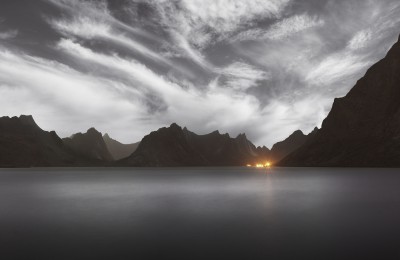
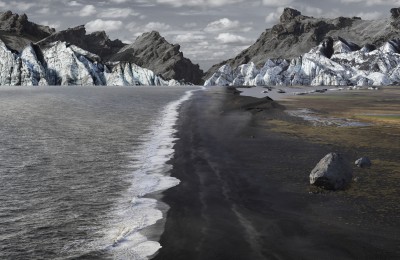
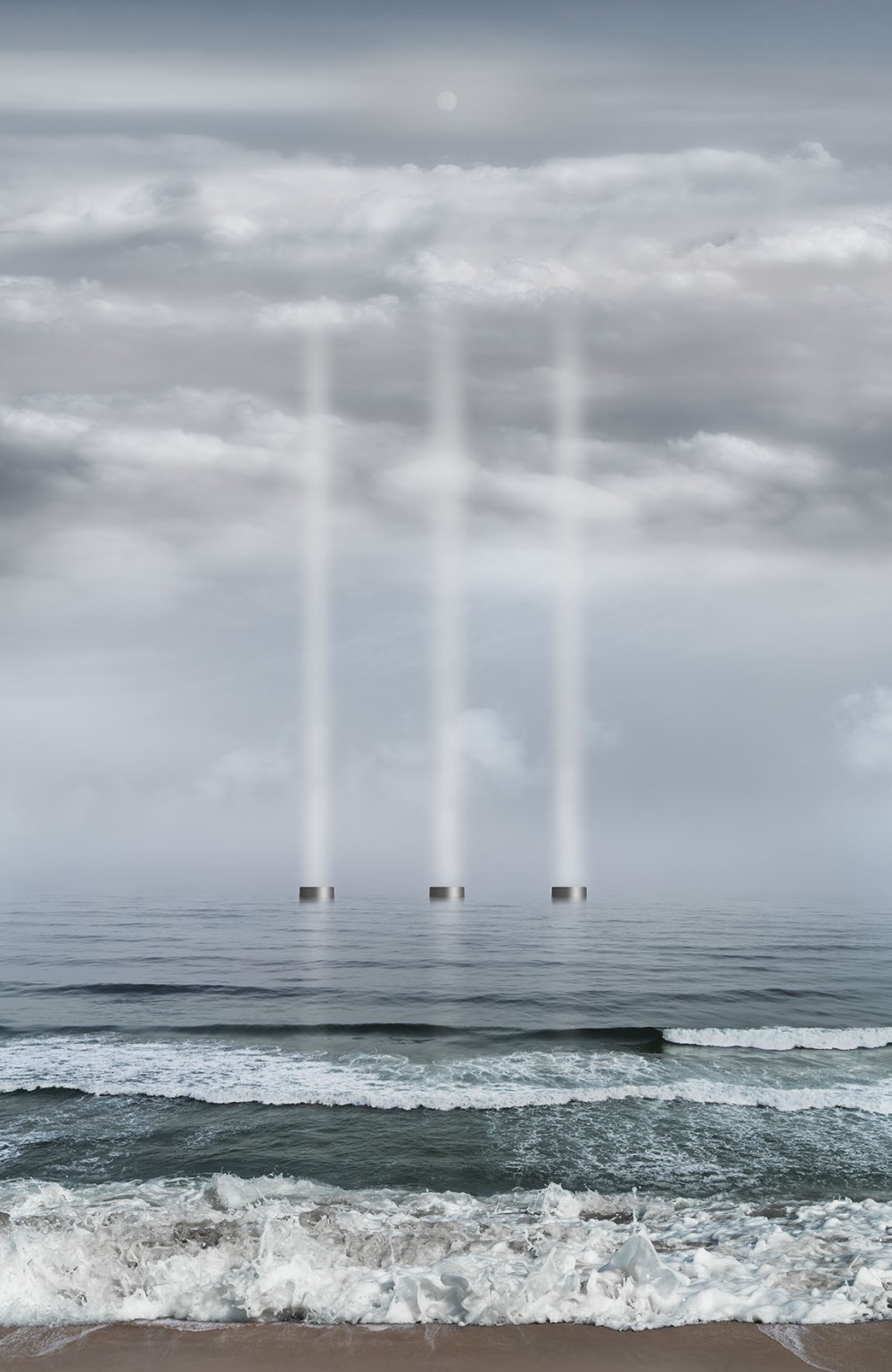
The artwork “cloud brightening” visualizes the idea of marine cloud brightening. The image composition consists of three elements: ocean, clouded sky, and three vertically ascending lines. The viewer approaches the scene from a floating, elevated perspective, observing the landscape from a distance. The gaze glides across a seemingly endless ocean toward the horizon, which disappears into mist and blends softly into the sky. The breaking waves echo the structure of the cloud bands above, while the wave at the lower edge of the image appears frozen in its dynamic motion. Sculptural formations reminiscent of coral structures momentarily suspend time and space. An unsettling yet central element is formed by the three vertical lines in the middle of the image, rising from the horizon into the sky. They disrupt the natural scenery and connect the ocean surface with the clouds. On a symbolic level, they refer to the principle of marine cloud brightening, in which low clouds over the oceans are deliberately sprayed with fine saltwater to increase their reflectivity. The lines thus function as visual interfaces between ocean and atmosphere, making human intervention in natural climate processes visible. In this way, cloud brightening condenses a scientific concept into an aesthetic experience while simultaneously prompting reflection on the possibilities and limits of human action within the climate system.